
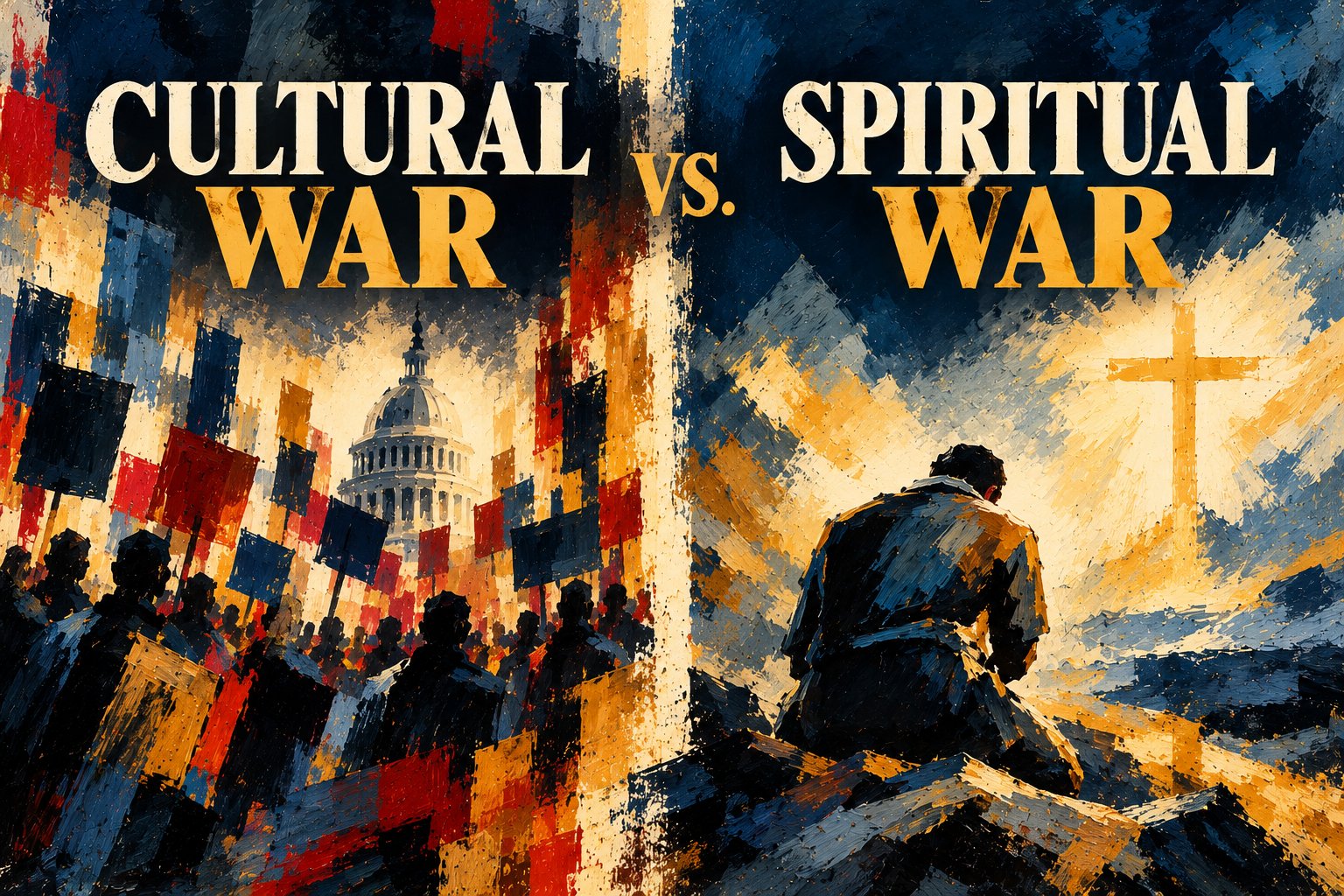
Are Christians Fighting the Wrong Battle?
“For the weapons of our warfare are not carnal, but mighty through God to the pulling down of strong holds.” — 2 Corinthians 10:4 (KJV)
Are Christians Fighting the Wrong Battle?
“For though we walk in the flesh, we do not war after the flesh: (For the weapons of our warfare are not carnal, but mighty through God to the pulling down of strong holds;)” — 2 Corinthians 10:3–4 (KJV)**
There is a war that believers have been called to fight. It is not a political war, a cultural war, or a struggle to gain control of the institutions of this world. It is a spiritual war.
Yet increasingly, Christians are being encouraged, and sometimes pressured, to enlist in what has become known as the *culture war
We are told that Christianity is under attack, that our values are being threatened, and that unless believers rise up and fight politically and culturally, we will lose our nation, our freedoms, and perhaps even our Christian heritage.
But I believe we need to ask a more fundamental question:
Is this the war Jesus Christ called His Church to fight?
I heard someone say this a few days ago, "nothing unites like fear" I believe this is a true statement in a negative way, we know that love is what truly unites, while fear unites the fearful.
- Our Warfare Is Spiritual, Not Carnal
The Apostle Paul makes a remarkable statement in 2 Corinthians 10:3–5:
“For though we walk in the flesh, we do not war after the flesh: (For the weapons of our warfare are not carnal, but mighty through God to the pulling down of strong holds;) Casting down imaginations, and every high thing that exalteth itself against the knowledge of God, and bringing into captivity every thought to the obedience of Christ.”
Notice what Paul identifies as the objects of our warfare: arguments, proud thoughts, and everything that exalts itself against the knowledge of God.
Paul describes the spiritual weapons as mighty through God, this is Gods battle, not merely our own, these thoughts or philosophy is aim against the knowledge of God, this why we cannot fight the battle culturally or politically, if we do, we may win but this is not for the glory of God or his kingdom.
Paul is not describing a campaign to seize political institutions or establish Christian dominance over society.
He is describing a spiritual conflict in which the truth of God confronts falsehood and human pride.
Our weapons are not political power, intimidation, coercion, or worldly influence.
Our weapons are spiritual because our mission is spiritual.
The gospel itself is the power of God unto salvation (Romans 1:16).
- The Cultural War Is Concerned with Society; Spiritual Warfare Is Concerned with the Truth of Christ
Cultural wars generally concern competing visions of how society should function.
They involve questions of morality, legislation, education, sexuality, family, religion, and political authority.
These matters are not necessarily unimportant. Christians live in society, and we have responsibilities toward our neighbors.
But we must recognize that the mission of the Church is not identical to the moral or political interests of any society.
A society may adopt Christian moral principles without embracing the gospel of Jesus Christ.
People may support biblical standards of marriage, oppose abortion, defend religious liberty, and promote traditional family values while remaining spiritually separated from God.
Moral agreement is not the same as regeneration.
The gospel does not merely call people to adopt better cultural values. It announces reconciliation with God through Jesus Christ.
Paul declared:
“For I determined not to know any thing among you, save Jesus Christ, and him crucified.” — 1 Corinthians 2:2
That was the center of his ministry.
It must remain the center of ours.
3. Jesus Refused to Make His Kingdom a Political Movement
When Jesus stood before Pilate, He made a statement that should shape our understanding of the Church's mission.
John 18:36:
“My kingdom is not of this world: if my kingdom were of this world, then would my servants fight, that I should not be delivered to the Jews: but now is my kingdom not from hence.”
Jesus did not deny that He was a King.
He denied that His kingdom derived its authority or character from this world.
His kingdom would not be established through the methods by which earthly kingdoms maintain their power.
This is particularly significant because Jesus lived under Roman occupation, in a society marked by injustice, political corruption, and religious conflict.
Yet He did not organize His disciples into a political resistance movement.
Instead, He sent them into the world to proclaim the kingdom of God.
The Church must never confuse the advancement of Christ's kingdom with the advancement of a political movement.
4. The Danger of Becoming Consumed With Cultural Warfare
My concern is not that Christians have moral convictions or participate in civic life.
My concern is what happens when cultural warfare begins to dominate the Church's identity.
We can become so consumed with defeating cultural opponents that we lose sight of the spiritual condition of those very people.
Instead of seeing sinners who need the grace of God, we begin to see enemies who must be defeated.
Instead of preaching reconciliation, we become preoccupied with confrontation.
Instead of demonstrating the love of Christ, we begin adopting the hostility and rhetoric of political movements.
And perhaps most dangerously, we begin measuring the success of Christianity by political victories rather than the faithful proclamation of the gospel.
But Paul reminds us:
Ephesians 6:12:
“For we wrestle not against flesh and blood, but against principalities, against powers, against the rulers of the darkness of this world, against spiritual wickedness in high places.”
Our ultimate enemy is not the unbeliever, the political opponent, or the person who rejects our moral convictions.
Our battle is spiritual.
The very people we are tempted to treat as enemies are the people Christ has called us to reach with His grace.
5. The Apostles Faced a Hostile Culture Without Declaring a Cultural War
Consider the world in which the apostles ministered.
The Roman Empire was filled with idolatry, sexual immorality, political oppression, and religious persecution.
Christians were a small minority with little political influence.
Yet when we read the New Testament letters, we do not find the apostles organizing campaigns to take control of Rome's political institutions.
Instead, we find them preaching Christ, establishing churches, teaching sound doctrine, caring for the poor, and calling believers to holy living.
When Paul entered Corinth, a city known for its pagan religious environment, he declared that his message centered on Jesus Christ and Him crucified.
When he wrote to the believers in Rome, he instructed them:
Romans 12:21:
“Be not overcome of evil, but overcome evil with good.”
This is not passivity.
It is a radically different approach to confronting evil.
The early Church challenged the Roman world, but its primary mission was not to conquer Rome politically.
It was to bear witness to Jesus Christ.
6. We Must Not Fight Spiritual Battles With Carnal Weapons
There is a temptation that confronts every generation of believers.
When we believe something precious is being threatened, we may become willing to employ methods that contradict the very gospel we seek to defend.
We may justify hostility in the name of righteousness.
We may excuse dishonesty because we believe our cause is just.
We may embrace political power because we fear what will happen if our opponents possess it.
But the righteousness of our cause does not sanctify unrighteous methods.
James writes:
James 1:20:
“For the wrath of man worketh not the righteousness of God.”
We cannot produce the righteousness of God through the anger of man.
Neither can we advance the kingdom of Christ by abandoning the character of Christ.
The weapons of our warfare must remain consistent with the nature of the kingdom we represent.
7. The Church Must Remember Its True Mission
Jesus commissioned His disciples to make disciples of all nations (Matthew 28:19–20).
Paul described the ministry entrusted to believers as the ministry of reconciliation.
2 Corinthians 5:19–20:
“To wit, that God was in Christ, reconciling the world unto himself, not imputing their trespasses unto them; and hath committed unto us the word of reconciliation. Now then we are ambassadors for Christ, as though God did beseech you by us: we pray you in Christ's stead, be ye reconciled to God.”
We are ambassadors for Christ.
An ambassador represents the interests of the kingdom to which he belongs.
Our calling is not to make the world Christian through political pressure.
Our calling is to proclaim Christ so that sinners may be reconciled to God through faith in Him.
This does not mean Christians must withdraw from society, remain silent about injustice, or abandon their civic responsibilities.
We can speak truthfully about moral issues, defend the vulnerable, and work for the good of our neighbors.
But we must never allow these activities to replace the gospel or redefine the Church's mission.
Conclusion: Are We Fighting the Wrong War?
I fear that many believers are becoming so deeply invested in the cultural battles of our time that they are losing sight of the spiritual warfare described in Scripture.
We are becoming skilled at identifying political enemies but less concerned with proclaiming the grace of God to sinners.
We are becoming passionate about changing laws while sometimes neglecting the message that changes hearts.
We are becoming concerned about preserving Christian influence in society while forgetting that the power of Christianity has never depended upon political control.
The Church does not need to conquer the culture to fulfill its mission.
It needs to remain faithful to Christ.
We must never become so consumed with winning the culture war that we forget the spiritual war we have been called to fight.
For the weapons of our warfare are not carnal.
And the kingdom we represent is not of this world.
Three additional biblical insights worth considering
1. Paul distinguishes spiritual warfare from ordinary worldly conflict.
In 2 Corinthians 10, Paul was specifically defending his apostolic ministry against critics. The strongholds he describes concern arguments and opposition to the knowledge of God. We should therefore be careful not to treat the passage as though Paul were directly discussing modern politics. Nevertheless, the principle concerning the nature of Christian ministry has important implications for how believers engage in cultural disputes.
2. The temptation to pursue worldly power is not new.
In Matthew 4:8–10, Satan tempted Jesus with the kingdoms of the world. Jesus rejected the offer and remained faithful to the Father. Although that passage is not specifically about contemporary political engagement, it raises an important question: Can the pursuit of power become a temptation even when people believe they are pursuing a righteous cause?
3. The Church can win political victories while suffering spiritual defeat.
This may be the strongest point in your argument.
A church can gain influence, obtain legal protections, and see its preferred policies enacted without necessarily becoming more faithful to Christ.
Political success and spiritual faithfulness are not interchangeable.
Likewise, a church can suffer persecution, lose cultural influence, and still remain spiritually faithful.
Consider the believers in Smyrna, to whom Jesus said:
“I know thy works, and tribulation, and poverty, (but thou art rich).” — Revelation 2:9
They were materially poor and afflicted, yet Christ called them rich.
That challenges the idea that cultural influence is the measure of the Church's success.